


Thoughts on Servicing etc by Portland Bill
Back to Hints and Tips
This is primarily for those who have not used their bike for a while but it applies to looking after your bike at any time of the year.
It's that time of the year when you might not have ridden your bike since the end of the last season. What's important is to check a few things before riding it, just to be on the safe side. Nothing really replaces regular servicing, and keeping the bike clean will mean that you are looking at all of the machine and therefore are likely to spot anything out of the ordinary. ‘Pre-flight checks' are an invaluable aid to safe operation of your motorcycle. Let's have a quick look at what to look at, and what to look out for. There are a number of acronyms for remembering this, such as POWER (Petrol, Oil, Water, Electrics, Rubber) or T-CLOCS (Tyres,Controls,Lights,Oil,Chassis,Stand) but the simplest is often the best, so make your own list that is easy to remember and becomes a routine that is quick to perform.
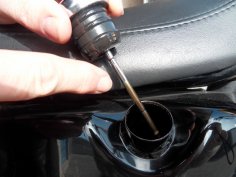 Let's start with the engine oil level, this is a critical one as the oil not only lubricates, but it also cools where an air cooled engine is concerned, so needs to be correct. Using the Sportster as our demo bike here, the oil dip-stick is on the right hand side of the bike as you sit on it, and is sticking out of the oil tank, or needs pressing down to make it 'pop-up' on later models. With the bike on level ground, parked on the side stand with the handlebars turned fully to the left, draw the dip-stick out and wipe it clean with a rag. Re-insert it fully and then withdraw it again and take the reading by where the oil reaches on the stick. It should be between the two marks on the stick when the engine is cold. After riding this can be repeated and the oil should reach the top 'full when hot' mark. If it doesn't, check with your dealer for the right oil, and top up the tank a little at a time until it does. Be very careful not to overfill it, as too much oil is as bad as having too little, for a variety of reasons.
With gearbox and or primary drive oils, you can usually leave these well alone between services. If in any doubt as to these, get them checked by a competent professional. Remember that old oil is dead oil. Be sure to keep up your service intervals as this will prolong the life of your engine.
Next let's look at tyres. Air pressures are very important as they can adversely affect the handling of your bike if they are wrong. Check what pressure your tyres should be inflated to, this information is in your owners manual, or available by a quick phone call to those friendly people at Riders. Treat yourself to one of those nice new tyre pressure gauges from a good retailer. It doesn't have to cost a fortune, and looked after, will give years of service.
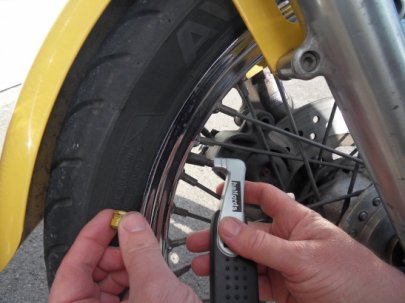 Using the Sportster as a demo again, ensure that the tyres are cold, (i.e. not ridden for at least three hours) as they heat up withriding and will give a false reading. Unscrew the dust cap on the tyre valve and press the tyre pressure gauge onto the valve stem to 'test' the pressure.Sometimes this takes a little practice to get the angle right and you often get a hiss of air escaping while you perfect your technique. Once properly seated, the gauge will give you a reading for the pressure in the tyre. Now I use PSI (pounds per square inch) which is an older measurement, but one I am familiar with and find most accurate. The pressures on my Sportster are 28 psi for the front, and 36 psi for the rear. Be sure and get accurate figures for your bike. To add air you will need a foot pump or similar, I don't recommend those pumps at service stations as they can often be wildly inaccurate and difficult to be precise with. Be sure and only do a few pumps at a time and re-check the pressure, as some pumps can really output a lot of air in a short time. If the tyre is over-inflated, press the small centre pin inside the valve stem and release a little air at a time and re-check it.